
New Paltz, New Paltz by Mike Powell: Into the Abyss
In La Vita Nuova, Dante is a passive figure onto which the process of love happens. Dante regards Beatrice, the love object, the love object, as the source of a metaphysical alchemy of the soul. The love object is not a participant in an exchange, but a prompt toward self-reflection and a turn toward the divine. In his lecture on La Vita Nuova, scholar Giuseppe Mazzotti refers to such a process of love as doing “violence on our way of thinking”. Love is transformative. Love annihilates the self. Love is absolute. At least, in Dante’s cosmology. In celebrated Pitchfork music critic Mike Powell’s novel New Paltz, New Paltz, Ben thinks he might have fallen in love with a girl one summer. “Apparently you either know or you don’t, and nobody comes around to confirm one way or the other,” our protagonist says in the novel’s opening paragraphs.

New Paltz, New Paltz by Mike Powell, Double Negative, 2025
New Paltz, New Paltz is the thoughtfully designed debut imprint of Tuscon-based press Double Negative under the leadership of writer Nick Greer, who brings to the curative act of publishing a musicology background and an inspiring ethos toward artistic citizenship. The novel is set in a quintessential New York summer, some time between when cell phones became ubiquitous, and when social media subsumed social interaction entirely and the phrase “male loneliness epidemic” entered the contemporary vernacular, at the apex of the roller coaster ride of the American empire, as vacuous materialism heralded a rapid descent into polarized echo chambers and disorientation of the masses. It is a New York holding the potential for wonder and warmth, though not without its patina of grifters and defeats.
Ben is an affable guy. He has a tender, observant orientation toward the world which is not dissimilar from the approach Powell brings to his music criticism pieces, such as a sentimental essay on The Silver Jews, finding the transcendent in Berman’s contradictory and unpolished vision of Americana. Ben works as a fact checker at a gossip magazine, a role which he accepts with detached awareness and general indifference. He’s willing to lend a helping hand when he’s asked, sometimes going to lengths to help others which verge on suspicious, as if he is trying to compensate for the void of meaning in his life he struggles to directly name. He does, however, seem to be able to access what passions he is dissociated from through his fixations, which include: a platonic ideal of a button-up shirt which stands in for his own potential for embodiment, a dog park near his home where he marvels at the lobotomized majesty of a cocker spaniel humping a mastiff, and a particularly charismatic coworker who he regards as a demi-god for his raw ability to indulge in a bit of hedonism. Such fixations seem to point to some underlying deficiency in his life, although he isn’t depicted as being consciously anguished about this, or anything really, which is the matter at hand.
We don’t really know a ton about the novel’s love object, Lucy, other than that she is an aspiring photographer hoping to intern under a Ryan McGinley type, is from the eponymous upstate town of New Paltz, and shares a commonality or two with Ben. Or so it seems to Ben, at least, but he seems to be subconsciously fishing for interpersonal connection to fill the void of purpose in his life. The two share a single sexual encounter, during which she provides a balm from the mosquitos plaguing his apartment (which I personally wish I was also aware of when I was dealing with a particularly vicious colony of mosquitos finding their way into my bedroom during my first New York summer). Lucy demonstrates a general aversion to being in an object position: she has no inclination toward accepting the offer to model for the photographer she wishes to learn from. The pair visit an art museum, seemingly just so that Ben can show her the painting The Mountain by Balthus, which particularly resonated with him. Where there is a mountain depicted by a man in Western art, it is almost certainly a symbol of self-actualization and purpose, something to be surmounted. “It was a meaningless moment in a sea of meaningless moments,” Ben describes in his experience of the painting, which depicts a group of people in various states of being on a journey set against the mountain landscape, warped in form by Balthus’s memories of his youth. The group is not directly interacting with each other, but “bound by some invisible understanding,” as in the symphony of coincident interpersonal interactions of New York, individuals living distinct lives but connected by some deep human longing. Lucy frowns on the unflattering depiction of the painting’s heroine, styled after Balthus’s young beloved, Antoinette.
At this juncture, I feel it’s necessary to address the Manic Pixie Dream Girl allegations, which I personally take little pleasure in doing, mainly because I think it’s an overwrought subject and a puritanical critique that is deliberately obtuse toward the potentiality of archetype and myth in writings on love. The MPDG is a mythic archetype, and a mythic subject never retains its humanity–I don’t see the justification in throwing the mythic baby out with the bathwater. Though, yes, technically New Paltz, New Paltz does meet the criteria, I do think Powell is smart enough to play with the trope, as evidenced by Lucy’s vocal objection to being cast as a photographic object and response to the Balthus piece. What is compelling to me about the MPDG is what she points to and away from: annihilation. In entering the protagonist’s life and prompting a total transformation in his perspective, she is a cardboard Hecate at a crossroads, stepping, as in Antoinette of The Mountain toward a potential for self-actualization, and thereby illuminating the architecture of absence. For our boy Ben, this absence extends from an ability to access embodied desire to a sense of purpose and agency.
The notion of the muse, as in myth or the concept of the MPDG, is an abstraction of a full human being. The abstracted muse-image takes on a life outside of the individual, liable to leave the individual she spawns from a hollowed skeleton, as in Edgar Allen Poe’s “The Oval Portrait”, where a man painting his beloved becomes so consumed by her image that he neglects to realize she has died sitting before his canvas. A catalytic event occurs in the novel when Ben learns that a romantic comedy actress, who he has developed a parasocial relationship to as he’s been fact checking about her at his job, committed suicide while filming on location. The tragedy echoes a text he sent to Lucy earlier in the novel, telling her “Flaubert thought every time someone took a photograph it took a sliver off his soul,” and asking if she agreed. Invoking the camera image throughout the text, Powell addresses the relationship between image and agency, running the risk of changing reality into a phantasm of memory.
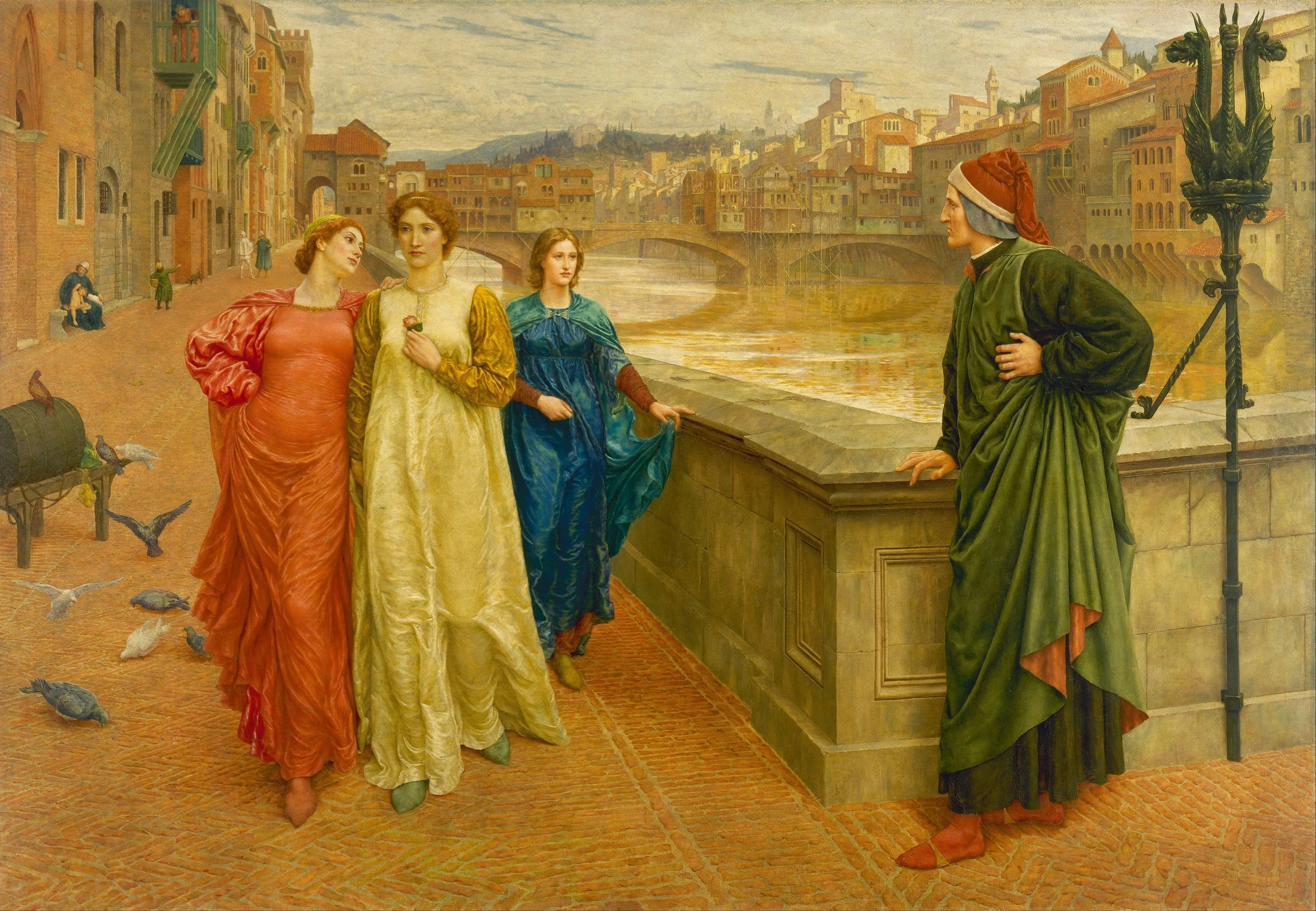
Dante and Beatrice by Henry Holiday, 1883
Just as the novel studies the way agency is stripped from the love-object, transformation in agency is also depicted as it manifests in the lover-subject, or in the case of Ben, the maybe-lover-subject. Where Dante’s experience of love is passive, in which the beloved becomes the subject and induces a transformation and passive objecthood in the lover in a kind of spiritual humbling, Ben is more agentic. Dante is made subject into object in his transformation, whereas Ben’s is one from object to subject. He wants to be someone who is given to passions and acts as someone who acts on passions. Ben goes after the girl, having snapped from his passive acceptance of the lack of meaning in his life into agentic action.
There is a strong connection between the experience of a transformation in the face of art and the experience of love, as transformative emotional and spiritual responses to an external phenomenon. The suggestion to visit the museum in the first place is prompted by Ben’s sage coworker Barry, who says he should go “if you believe art has the potential to redeem life.” Ben goes to the museum on his lunch break, seeking a resurrection of his own, joining the chorus of museum-goers Ben observes to be “waiting for the art to happen to them”. Invoking this Nietzschean idea that humanity has lost its way but through an artistic experience might find true spiritual fulfillment and redeem itself, Powell sets up the text in a kind of parallel to the narrative of Mahler’s Resurrection Symphony, which first announces a societal experience of living death, induces an ecstatic spiritual transformation, and culminates on a note of naturalistic longing, an ambiguous hope that this life is not meaningless. In the end, Ben chases down Lucy in her hometown of New Paltz to find her cohabitating with a partner, and as the gates of New York open onto the abyss, the world is not one where desire is resolved, but one of potent, weird ambiguity.
There is a movement from one form of ambiguity, one of a void of absence, characterized by apathy and absolute vagueness, to another, of potentiality found through varied interpretations. Leonard Bernstein, in his famous “The Unanswered Question” series of Harvard lectures, asserts that poetry emerges when potentiality of meaning emerges from the introduction of ambiguity. Such indeterminacy invites the mind to exercise its own agency, to participate in the product, to probe for potentialities. A rupture from apathy does not necessarily emerge from awareness of the void, but desire necessarily cannot be apathetic and detached. Ben, while he makes an attempt to overcome the void of meaninglessness through his pursuit of embodying desire and agentic action, ultimately does not seek to resolve the ambiguity of Lucy’s feelings for him or his feelings for her. There is a kind of optimism in this. When Ben says “I might have fallen in love,” he is really saying, “I might have broken free from my dissociative, intellectualized orientation toward the world.” This too, is ambiguous.
Bernstein pinpoints this ambiguity to be characteristic of the human spirit, to accept our defeats and press on in desire, relating the introduction of ever-increasing musical ambiguity to what he perceived to be the crisis of the twentieth century, that of humanity’s total annihilation. “Greed and hypocrisy leading to a genocidal war, post-war injustice and hysteria, boom, crash, totalitarianism,” Bernstein refrains in his lectures, articulating the twentieth century’s cycles. We encounter New Paltz, New Paltz set in the midst of the transition from boom to crash, delivered to us as we complete one cycle and move into the next, the unplugged and analog representing a new pastoral hope in the wash of disembodied images and dehumanized text. A new material desire emerges from the digital pit, we publish our homies, we go on slowly considering the potentiality in art in a strain to truly connect to something, ever continuing on, into an unpromising abyss.
KAT BEAMAN