
hanging out is of utmost importance - on Rainer Diana Hamilton's Lilacs and Anne Waldman's Archivist Scissors
I’ve been on a total media fast for nearly a month and have actually found myself enjoying the process of dishwashing.
I’ve been trying to observe bathroom reverence, not be on my phone scrolling when I’m in there.
I threw in for good measure, I’ve been trying to leave my headphones at home more, listen to the sounds of my environment when I’m commuting, or on a walk around my neighborhood.
The group is gathered for Attention Activism 101, a course doubling as a cell phone addiction support group, offered by the Strother School of Radical Attention (SSRA), a Brooklyn-based education organization whose mission is to combat “attention fracking,” a recently coined term which refers to the practice of data companies to prey on our attentions and addictive relationships with technology like a junk food company in order to mine data, often for algorithmically-tailored marketing. Our algorithms whisper sweet nothings into our consumerist ears, numbing our awareness of the world around us, displacing our relationships, both intimate and collective. SSRA draws a parallel between attention fracking and pollution, in that it is a phenomenon we are by and large exposed to our will and which is toxic to our well-being, industrially driven, though contributed to by individual complacency within an infrastructure which isn’t designed to serve our well-being, but mostly to make money.
In 2024, concerned about how the Spotify algorithm funnels listeners toward industry plants, I began to structure my listening habits in a researched fashion, tracing lineages of influence by rooting my listening habits in an understanding of the artistic product as breathing from the same air as its reference, fundamentally given its shape by study and attention. Yet as I tried to implement an intentional orientation toward the media I consumed, still within the Spotify platform, I developed increasing reservations toward the platform altogether after witnessing increasing concerns from my musician peers about the platform’s hoarding of profits and failure to pay artists reasonably.
I cancelled my subscription as my New Year’s resolution for 2025, surrendering my access to memories stored in my obsessive taxonomy of playlists. In June of 2025, Spotify CEO Daniel Ek invested $700 million of those hoarded funds in the AI military start-up for which he serves as the chairman, as the Spotify algorithm funnels algorithms toward AI-generated music, bypassing musicians entirely. As I emerged from the cocoon of my headphones in the springtime of my first year post-Spotify, I started to suspect that maybe we aren’t meant to be constantly listening to music, worried that maybe this has done something to our reverence for music and slightly displaced us from our environment, in a state where we are hearing but not listening, but mainly avoiding our own thoughts.
At the same time as we wipe the sleep from our lullabied eyes and become aware of how much time we have spent sucked into a portal of algorithmic images, we have been grappling with the spread of AI and its impacts on the environment, as a result of the water needed to cool its data centers. It seems an essay cannot be published these days without grappling with the implications of AI on literature–and I, clearly, have not yet moved past this. We have questions about agency and intellectual property in a time of increasing economic division, at least in the US. We suspect that outsourcing our ideation, investigation, and reflection to generative AI might have negative impacts on our cognitive faculties. We are in a moment of interrogating what it means to be human, to make human art, to have human memories, distinguishing the generation from the generated image from the image which is characterized by the subjectivity of the human “hand”, the notion of the distorted human memory of sensory experiences stored in the body, crystallized around social seeds, fermented by emotion, from pure data storage. It is what we remember, the moments which stick out over the noise which defines our memories, a process which requires the erosion of our less potent memories, which is more definitive of the lives that we lived than how many things we retain. In the library of babel of possibilities, it is the words that we choose to write that matter.
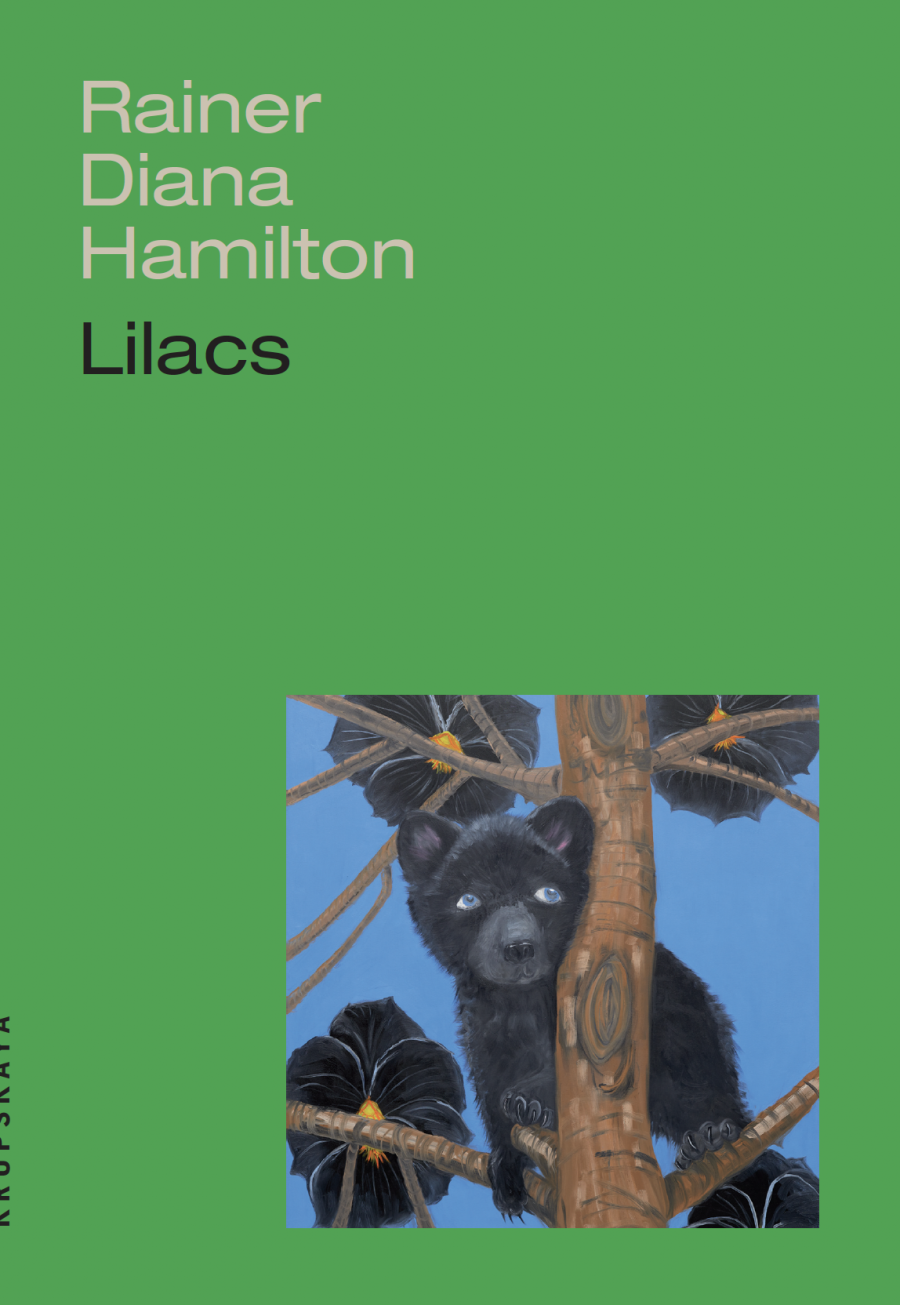
Lilacs by Rainer Diana Hamilton, Krupskaya, 2025
As to the concern of outsourcing over our intellectual independence to technology, this has been going on for some time before AI came along. Already, many of us are so reliant on GPS to navigate the world that we struggle to understand how our neighborhoods lay in space, having ceded over our spatial understanding to our devices, alienating us from the knowledge of where we live. It is in a predicament of spatial dissociation and consequent disorientation from one’s surroundings from which Rainer Diana Hamilton invents and executes the poetic form of the lilac, named apparently for the lilac bush in front of their stoop serving as a familiar lighthouse, after taking the wrong turn on the way home, and trying to recall the memory of landmarks of their neighborhood in Brooklyn.
Hamilton writes in prosaic language,
Later, distracted
On my walk home by the kiss’s memory, which came
easily because my eyes had been closed for it, I took a wrong
turn and struggled to find my building
on an unfamiliar street. That’s why I’m studying:
There is my own blue bicycle; the round planter to the left
of the steps I used to enter, which the downstairs neighbor keeps
tidy---cutting back the plants that don’t stay green
in the winter although I’ve never seen her do this work…
and after much meandering,
There is a lilac bush immediately next door, and in May,
it helped me
identify my building from very far away.
In Hamilton’s stated framework, the score of the lilac’s poetic form is, “a poem written, prosaically, in an artificially-induced trance-like state, for the purposes of remembering something sensual.” They continue, “not just to enter a trance that enables the recovery of senses and their memory…” but “to focus, to put a filter on awareness.” In addition to and preceding the poetic form derived from its name, as executed in the text, the lilac stands in as a symbol representing a drive to reclaim our faculties and attention from capitalist consumption, sometimes through queerness (another subversion, a reclamation of the body and its desires), a sweet moment shared with a friend while running out of gas on a road trip, generally finding one’s way in the world, but not being in any particular rush to get there.
Using the amorphous, non-chronological (as in memory) form of the self-defined lilac, Hamilton presents us with prosaic poems which gently untangle the knot of how senses, memory, and friendship are intertwined, providing philosophical exposition of the schools of thought which consider them, interwoven with personal recollections, in a structure which wanders far, far away from the over-simplified bullet-point lists which have now become so ubiquitous, into an unwieldy trove of background research.
In the place of the lilac on taste, which is largely considered with respect to its use in the sense of “preferences”, as in art, music, and style, Hamilton includes a playfully rococo epistolary exchange with fellow poet and beloved friend Bianca Rae Messinger, referencing a literary history based in correspondence between friends, the notion of the writer as the person “of letters”, the fundamentally social roots of literature. In their writing to Messinger, they acknowledge the exercise in memory as a self-oriented pursuit, while simultaneously positioning themselves in dialogue with history of collective ideas and inherited lineages of thought. Hamilton is not only extraordinarily rigorous in their research but might just be one of the cleverest poets doing it right now. Even so, they aren’t too self-serious--their tongue is pressed firmly in their cheek, making quippy and congenial observations as they meander almost but never pointlessly, as an acquaintance you chat with at a cocktail party where, sitting sideways, you share intimate and profound conversation which rattles around in the brain for weeks to come.
In spite of writing a book in pursuit of the senses, Hamilton is not exactly an advocate of potent sensory experience. They are at times finicky and sensitive, prone to anxieties and overstimulation. They acknowledge the value in overlooking the senses, to surpass the body and its unnecessary opinions, avoiding the pain of perception, as “to perceive is to hurt”. They even equate happiness with sensory quietness, finding bliss in the peace of the body. Which is, however, a form of sensory experience itself—we would not know the stillness of the body without the body.
Their lilac trance begins with documentation of an attempt to recall smells, a Beethovian pursuit after having lost their sense of smell. They find smell to have limitations when it comes to memory, saying that its recall “cannot be conjured as reliably as a building whose architecture you’ve mapped in your mind”. Smell’s gaseous ambience eludes definite spatiality. Smell is vibes-based, associative, they observe of its memory mechanics that a smell, “does not trigger the memory of smell itself, but something else related to it”.
Hamilton has widely varying relationships with the senses, largely panning the experience of sound, resenting it for the lack of agency we have over sound in comparison to the other senses, not being able to escape a sound as easily as one can escape a sight by closing one’s eyes or a taste with a dinner mint. It is perhaps the lack of control we have over sound which places it the most proximate of the senses to the subconscious and dream state, and seemingly why it is “the medium for unwanted or at least unintentionally stored memories,” as Hamilton puts it. Sound occupies an interesting paradox, because though we have little agency over our receival of it from the environment into our body, our attention to it is not always active in the same way which one might maintain visual perception. Our ears are trained toward sounds which are tied to emotions, the “dishes washed in love or rage” and “the heart beating against the pillow.”
This filtering is key, for as nebulous as the lilac is, Hamilton’s trance exercise seeks not simply to uncover that which has been buried, but “to focus, to put a filter on awareness”. Like a mother selecting what mementos of their child to store in a box in the attic which she will give to them at the appropriate adult age, to give attention to and remember what matters, we must first determine what matters. Awareness of the world first occurs in the body, the body the first intercessor between the world and the mind. It is in the fermentation of the consciously or bodily selected image, where we discern meaning from our experiences. The memory takes on a linguistic quality, acting as a symbolic medium—the memory of the touch of an object standing in as shorthand for a wayward sexual encounter, for instance.
Prior to Lilacs, what I knew about Rainer Diana Hamilton was that they are an intellectual companion to Shiv Kotecha, who is featured in Lilacs as a roommate moving out, and who in his 2019 book The Switch also featured a person named “Diana Hamilton” prominently in describing at length how he didn’t want to fuck them. The Switch is a similarly intertextual book, drawing in references to one’s contemporaries as well as an intellectual lineage New York School poets, such as Kenneth Koch and Bernadette Mayer. If anything can be said of the New York School, it is that they were conversational. Their works were often collaborative and intertextual, weaving in references to other writers and painters of their milieu, and actively engaged with the musicality and psychogeography of the city itself. The New York School as a movement fundamentally rooted in friendship and collaboration, and as I discovered, often messy romantic entanglements. It is because of this abundance of interpersonal reference, the showing of one’s work and understanding of its place in a collaborative fabric which their body of work shares with the New York School before it, that I’ve understood the Kotecha-Hamilton extended universe to be something of a Third Generation New York School, if I may take the liberty of making that call.
More than being a book about memory or sensing, Lilacs is a book about companionship, particularly of an intellectual nature, for memory is rarely a solitary act. Love, as an experience of the body in the sense that the body intercedes between the stimulus and the psyche, is considered by Hamilton to be a sense. Companionship is framed as essential to how we process thought, curating for others’ attention, having conversations which help us to connect ideas, to reiterate that which we recount to a friend. Reliving a moment by sharing it with a companion solidifies it as memory. Remembrance under love, of love, is so often viewed with a lens of destiny and divinity. What is worth remembering, the point of anything, without friendship? Hamilton envisions a paradisical scene of friendship,
life now being worth living, so that
friendship could be longer, too, to be so good, even
at being friends that we would become more lovable
to everyone else, that we would move through the world
sharing at least two thousand meals, maybe five, with others
coming and going from the same long table
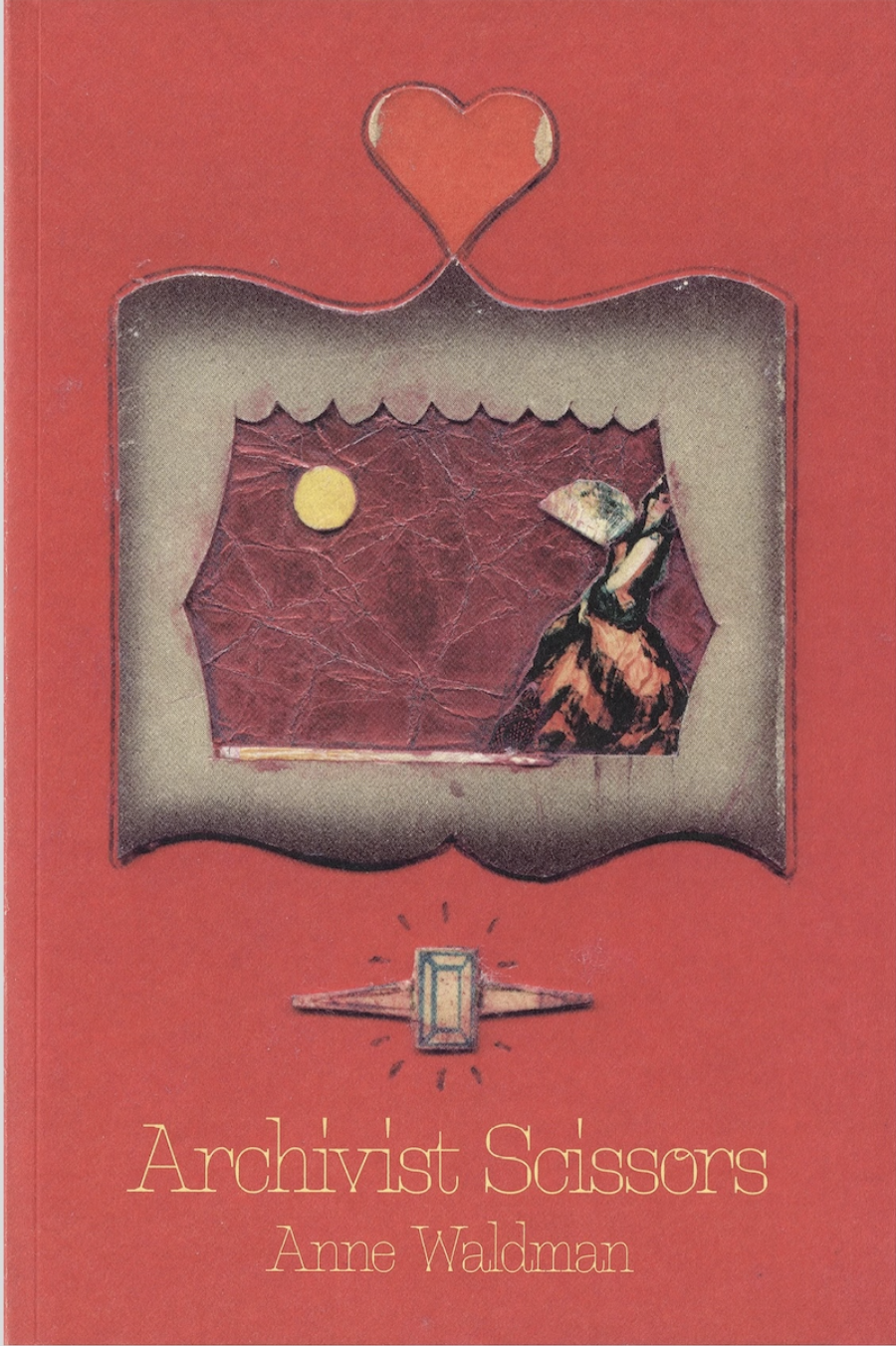
Archivist Scissors by Anne Waldman, Staircase Books, 2025
In Archivist Scissors, the living matriarch of poetry Anne Waldman revisits memories and retrospectives of her peers, eulogizing the lives and work of her collaborators and the friends alongside whom she came into her artistic development, extending the torch to the next generation. Where Hamilton’s poetics in Lilacs meander and settle into currents, Waldman’s stylistic portrayal of memory is written in pangs of red, resonant and primal, as she seeks the ancient, fundamental, and ecstatic in the lives of the artists she has borne witness to in her lifetime. Waldman is a fiery woman of conviction (an Aries stellium), but I feel she is at her strongest when she is reverently personal. Her signature deviations from grammar conventions (e.g. “Until music shifts purposeful your hearts”) makes the poem feel as if it is being impulsively delivered in the process of being brought to cognition, assembled from fragments of a pre-lingual dream. As she mourns her friends, she mourns too the planet which humanity is carelessly letting slip through our fingers, watching this planet go up and flames and wash away.
In “Martha Diamond Keys to the City”, in which Waldman eulogizes the painter alongside whom the poet came into her art practice, Waldman captures Diamond’s “darting and slashing” brush strokes through language, positioning herself as Martha Diamond’s foil while offering her poetic interpretations of Diamond’s timelessly urgent abstracted paintings of New York buildings, perhaps originating her own guttural, visceral poetic phrasing as bursting from the same yolk as Diamond’s “wild strokes the gates to the center of this hold on pulse”. In this poem, Waldman characterizes Martha Diamond’s work as emotive architectural impressions which are able to hold passion and deliberateness in counterbalance, epitomizing for Waldman what it means to be an artist. Waldman writes of Diamond’s paintings of city structures in ekphrastic descriptions which are inverted in form, “Pure what you see around the bend, corner / the willful / And conversation? In the paint outer / Attitude? Shell?” creating the feeling that something has been re-arranged and cut up, borrowing also from the tradition of influence spawning from Brion Gysin, William S. Burroughs, John Cage, etc.
Waldman describes the buildings in the paintings as “zestfully urbane as the perambulatory poems of Frank O’Hara”, connecting the New York School poets and painters by the experience they share of New York. Yet the origins of Diamond’s brush strokes are traced further than the New York artistic forbears of the 20th century, as Waldman connects Diamond’s work to an ancient artistic lineage, when, in her poem, she writes, alludes to “What she says of / The shape of things in time”, seemingly referring to Deep Time, the 2024 survey of Diamond’s work at the Aldrich, which was conceptually inspired by a quote Diamond delivered in an interview for the Whitney Biennale 1989, “Your life is defined in time. The way I relate to this in my work is by thinking of infinity: to the time of religion, of history… using shapes that have been significant to people for thousands of years.” Martha Diamond sought to communicate something essential to human expression through her expressive buildings by transcending time and accessing symbols which are collectively and historically significant (yet where we seek what is ancient, what is fleeting is also revealed). In Diamond’s work, this “deep time” of reverberating rhythms, where buildings echo trees and dolmens, is colored by primal fury and passion, which Waldman mirrors in choked phrases gasping for air and vivid imagery riding the cusp of being linguistic.
The built environment, as depicted in art, psychogeographically stands in for the soul and passions of the lives lived within it. If Hamilton asserts that love is a sense in that it occurs in the body and filters through emotional associations into the fomenting of memory, I might say that a city, too, is a sense. The city is a site of emotional resonance, a place of potentiality for states of being, bounce, forward movement. It exists as much in imagination and collective memory as it does in reality. We experience a city through the memories we make with people. Here, memory moves in ecstasy, transitioning between Waldman’s impression of Diamond’s paintings to stepping into the past by way of whirling dervishes who transcend time, locked in a tense relationship between the ecstatic, which dances with the eternal, and the past, so temporal, so temporary, so of this world.
While both Lilacs and Archivist Scissors are purportedly about memory, they are ultimately about friendship. Both texts are heavily intertextual–Hamilton angled from a stance of research and study, as in their beautiful defrocking of their bookshelves, foraging for a poem to present to a friend for their birthday, and Waldman as a scrapbook of photos and mementos shared with a loved one on a couch. Hamilton presents a rigorous lineage of philosophical perspectives on matters such as nature vs. nurture’s influence when it comes to matters of taste, though in their presentation of competing arguments, they also have a tendency to verge on negating the whole exercise of rigor altogether, declaring it worthless if not from a place of interpersonality.
In an essay they wrote on the poet Bernadette Mayer in 2021, Hamilton writes, “Mayer's work invites a reader to respond, certainly, but it's an invitation to keep a dream journal, to start a poorly funded magazine, to document one's life, to cross professional boundaries with a therapist, to ruin your social life by running off with a friend's husband, to quit one's job and spend time with lovers, to write letters and not send them… To write academically, after reading her books, is to RSVP for the wrong event.” In Lilacs, Hamilton frames taste as a magnetic pull of destiny, the magical circumstances which led both Hamilton and myself to the currents of the New York School, gravity formed in the literary spacetime continuum in no small part by Waldman’s contributions through Angel Hair Press and her work co-founding and serving the Poetry Project.
Waldman opens her poem “Bouyant” with a quote from Bernadette Mayer,
Even if the water rises
We will set up new and deeper memorials
To the trailing off of our plans.
Now more than ever, when we are increasingly estranged and the mementos we be leave behind evaporating in the ephemeral cloud, it is essential for friends to take up poetic attentions toward one other, and for poets to bear witness to the individual lives that they touch. For both poets, there is an understanding that we never write alone, that when we write, we exhale the artistic lineages of those we have given our attentions to. It is a shame it is so common for writers to fall trap to the hubris of original thought, when it is such a joy to read a writer reading. There is this cheesy quote I love that floats around the internet sometimes with a practically untraceable source but is generally attributed to Borges, “I am not sure that I exist, actually. I am all the writers that I have read, all the people that I have met, all the women that I have loved; all the cities I have visited.” We integrate our social spheres and the art we take in into our own consciousness, which interacts with a dynamic, shared consciousness, not so much in the form of the aggregating of language that one might seen in a large-language model, but in inter-becomings, becoming ourselves by decoupaging symbolically potent fragments of others onto ourselves.
Archivist Scissors is something of a primer to forms of attention that Waldman has seen her associates give to one another. She delineates the difference between sensory hearing and attentive listening in the poem “Existential”, which is dedicated to music producer Hal Willner, an active collaborator with the literary world who dedicated much of his career to spoken word recordings of work by such poets as Edgar Allen Poe, Allen Ginsberg, and William S. Burroughs, when she credits Willner as having “brought out the gleam in us with his wit and meticulous ear—we’re still listening…” The poem bears witness to a man’s dying phantasms, ultimately grasping for connection amidst quarantined isolation, portraying the crowd who has learned from Willner how to listen now acting as a chorus of angels, connected by the act of giving attention. The lesson which Waldman has learned from Willner, and which she imparts upon us is that what draws us away from art and from each other is an infected mentality of a complacent life.
Pain in the body and fidgeting, too, can be a form of attention, as when Waldman introduces us to the mystical filmmaker and poet Harry Smith through a list of actions punctuated by commas, indicating a state of unrest, “what pause, tick, jerk, pang, dwell here, smoke screen / what notch, twitch, tidbit, makeshift table, the chairs are always awkward.” Bearing witness to Smith’s suffering, she articulates the pain of loving someone whose burden you can’t do something about, but you want to, so bad—“genuine ornery compassion: / seeing your friend having a nightmare / you know how it is real / & how it is not real too.” And then when they’re gone, all you wanna hear is more bad news.
In her poem “Assignment”, which imagines a situation in which Waldman is being interviewed about Joe Brainard, as if under the premise that her most significant contribution to literature was to have published Brainard’s I Remember, Waldman quotes a fragment of a letter Brainard wrote to her, “I also feel that it is about everybody else as much as it is about me. And that pleases me.” It is crucial that we realize sooner or later that the greatest tool for fostering art is simply hanging out, tossing around ideas with each other, fiddling around, directing each other in ways which we might not have otherwise considered, integrating each other into ourselves, remembering each other. Stein’s salons, the Situationists’ dérives, writers in exile in Paris and Mexico City during Cold War-era dictatorships and coups orchestrated by the CIA, countless coffee shops, patios, and porches. The offhand comment a friend makes, a stray observation, cracks open a yolky egg of resonance and potentiality. These are the moments where entanglements occur which result in pushing each other beyond our existing perspectives, where we form collaborations, and where we crystallize each other’s work through translating, publishing, and reviewing each other’s art.
It is not independence which we lose when we outsource our thoughts to technology, but interdependence, the sharing of thought with each other. We read for each other, we read the things we recommend to each other, we read with each other, we read each other. We pay attention to the world to tell each other about it. We see each other in our dreams, and we share them, integrating each others’ dreams into our psyches, percolating into our own dreams. We are each others’ muses, the very idea of “we” a muse itself. We remember the world, the places we inhabit, in our memories of each other, creating lighthouses to guide each other in navigating this big mess we’ve landed in.
When we pass over, we turn into the memories that we leave behind for others, and only we can remember each other. Databases may save every tap and click, know our innermost desires. Our machines may mimic our mannerisms and affects. They may master our syntax. They may memorize every word we write, but they do not do it out of the necessity to preserve which only comes from love. Where AI may identify the sound of a dog panting in an audio clip, we hear the comforting breath of a steadfast companion. We contain the context which gives a stimulus meaning. A memory distorts the past, creating mythologies. A dream renders the archetypes we form from memories into new configurations to make sense of the world. A poem functions as a vessel which transports us from the memory to the dream, a process of mythology building, of honing in on images with attention, capturing the image in its resonance, often when the resonance has become traumatic, an inescapable refrain of symbols. It is the poet’s duty to declare what matters. A poem is an archive of the indefinable magic of our experience with each other, shared with each other.
KAT BEAMAN, 2025